


2023.08.09
What the hell is the shikibi that you are offering? ?
query_builder
2023/07/12
Seto Inland Sea
Ocean scatter
Nationwide
remains
Trader
family
Boarding
feel safe
Columbarium
correspondence
deceased
consultation
Thank you for visiting.
Before I got a job at Murakami Stone, I was once asked to run an errand to buy a sakaki tree for a household Shinto altar. At the time, I didn't have any knowledge about it, and I didn't even know that there were two types, Sakaki and Shikibi. It was then that I learned for the first time that the gods were decorated with sakaki trees and the Buddhas with shikibi. At that time, I have bitter memories of not even knowing the difference between Sakaki and Shikibi, rather than the fact that I failed to run an errand.
I have thoroughly researched acne, so today, let me talk about acne.
What is shikibito?
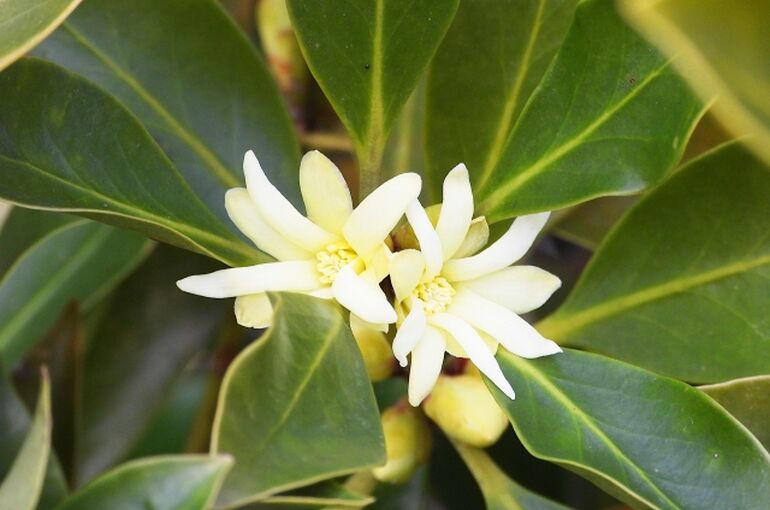
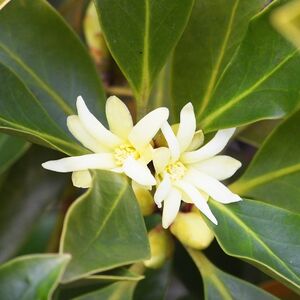
Shikibi is a plant that belongs to the genus Shikimi of the family Chrysanthemum. Grows to a height of about 10m. Around March to April, pale yellow flowers bloom. As you may know, it has a thick, gently undulating leaf shape. The language of flowers is "aid", "sweet temptation" and "venomous". As the language of flowers suggests, every part of the shikibi is poisonous. Care should be taken to prevent accidental ingestion by small children and pets.
Shikimi? Bruises? which is correct?
It was written as "樒" in kanji, and was originally read as "shikimi", but the pronunciation of "shikibi" has spread due to the accent, and both spellings can be seen. So both readings are correct.
Why are you offering the squeak?
〇 As a demon repellent
Legend has it that the strong scent emitted by Shikibi wards off evil spirits. In the days when there was no dry ice, only Shikibi was able to eliminate the odor of dead bodies from the time they died until they were buried. Therefore, it has been believed that the shikibi, which extinguishes the scent of death, has the power to protect the corpse from evil spirits and ward off bad things.
〇 Remnants of the burial era
In the days when burials were burials, stray dogs and wolves often ransacked graves. Therefore, people began to offer squeaks, which have a strong scent and poison. It would have been perfect for avoiding animals during the custom of burial.
〇 As an insect repellent
Among the ingredients contained in the strong scent of Shikibi, there is also an insect repellent ingredient called safrole. This safrole is still used today as an insecticide for fleas and ticks, and its effectiveness is recognized. Therefore, it is considered very good to offer Shikibi when visiting a grave to prevent pests from polluting the grave.
Origin of name
There is a theory that it was named "Shikimi" because it maintains a beautiful green color throughout the four seasons, and it became "Shikimi Shikibi".
Other than that, there is a theory that the name 'bad fruit' came from the fact that the fruit has a strong poison, and another theory that it came to be called 'makimi' because the fruit can be spread all over the ground, and it became a moss. I have.
What is the difference between Shikibi and Sakaki?
The difference between shikibi and sakaki depends on whether it is Buddhism or Shinto. Shikibi is used as a memorial service for the deceased and as an offering to the Buddha. On the other hand, Sakaki is also used for offerings to Shinto shrines, groundbreaking ceremonies, construction ceremonies, Shinto funerals, and Shinto wedding ceremonies. Although it differs depending on the region and sect, basically it is divided and used like this.
Shikibi and Sakaki are very similar, but they are used for opposite purposes, so be careful. If you acquire knowledge about shiikibi, you may be able to visit the grave with a different feeling than usual.
----------------------------------------------------------------------
Shimanami Memory
address: 114-9 Kamitoku Otsu, Imabari City, Ehime Prefecture
telephone number: 0898-47-3441
----------------------------------------------------------------------
NEW
-
-
2023.08.02legal affairs and leg...law and legal affairs Thank you for visiting. ...
-
2023.07.26About the memorial towerThank you for visiting. Today, let me talk abou...
-
2023.07.19About posthumous namesThank you for visiting. Have you ever heard the...
-
2023.07.12What the hell is the ...Thank you for visiting. Before I got a job at M...
-
2023.07.05history of graveshistory of graves In modern times, there are va...
-
2023.06.28What should I do with...What is shukatsu? What do you prepare from? Tha...
-
2023.06.21About prayer beadsThank you for visiting. My grandfather passed a...
-
2023.06.14About the five-ring t...Thank you for visiting. I joined the company in...
-
2023.02.07Ehime Graveyard | Wha...2023/2/4 Dear Ehime Prefecture, good morning. ...
-
2023.01.23What do the cucumbers...Hello! Thank you for visiting. I used illustra...
-
2023.01.16Oshima Stone in Imaba...Hello! Thank you for visiting. Have you ever ...
-
2023.01.11About visiting gravesHappy belated new year. Thank you for your cont...
-
2022.12.22Grave hunting in Imab...A cemetery is not only a place to store the rem...
-
2022.11.10Visiting a grave|The...hello. Shimanami memory, which is familiar with...
-
2022.11.10A blogger who publish...The homepage of the world's first completely ha...
-
2022.07.05Matsuyama City | Wher...hello. Shimanami Memory is familiar with comple...
-
2022.05.10Ehime Prefecture Tomb...What is the grave that I can't hear anymore? No...
-
2022.04.19Shimanami memory for ...Marine bone-cutting is a new form of offering t...
-
2022.04.19We have launched a ne...Thank you for visiting our blog. We have launch...




VIEW MORE
