


2023.08.09
history of graves
query_builder
2023/07/05
Seto Inland Sea
Ocean scatter
Nationwide
remains
Trader
family
Boarding
feel safe
Columbarium
correspondence
deceased
consultation
history of graves
In modern times, there are various methods of memorial services, including permanent memorials, ocean scattering, tree burials, hand memorials, and graves. After all, I think that there is a great desire to enter the grave and to bury the ashes. Today, let me tell you about the history of the grave and when it started.
the reason for building a tomb
There are three main reasons for building tombs.
〇Firstly, the grave is also called the “last dwelling place”. I think everyone has the desire to build a last home for the deceased.
〇Secondly, the bereaved family will have a place to rest. It is an unimaginable sadness when you lose someone important to you, but it calms down over time and you can feel close to the deceased when visiting the grave.
〇 Third, you can secure the destination of the ashes for generations. Not only does it save the time and expense of building a grave for your descendants in the future, but it also gives you peace of mind knowing that there is a grave that you can enter in the future.
Since when is the grave?
It has a long history, and there has been a culture of burial since the Jomon period.
【Jomon Period】
There were many "pit graves" where the deceased were buried in uncut pits. Then, they performed a burial method called “bent burial,” in which they squat down like a baby in their mother's womb.
In addition, it is said that this ritual was performed to prevent the soul from returning to the body, as earthenware was also found placed on the chest of the remains.
However, at this time there was no culture of placing stones on the soil of burials.
【Yayoi Period】
In the Yayoi period, a mass cemetery was built and buried in a separate place a little away from the village. Since it became clear that the individual would not be revived, and because there was no time to bury the deceased with their arms and legs bent, there were many “extended burials” in which the limbs were extended.
In the Yayoi period, the most common type of pit was the pit grave. Next, there is the slightly splendid “wooden coffin tomb” and the most splendid “stone coffin tomb”.
Wooden coffin graves are coffin graves made by combining wooden boards. It is said that the culture of encasing the deceased in a wooden coffin was introduced from Korea during this period.
A stone grave is a method of burying the deceased in a space made by piling up small stones and piling up larger stones on top. The stone grave was the grave of the higher rank.
[Kofun period]
As the name suggests, it is famous for its ancient burial mounds. Ancient tombs were built with a large amount of soil piled high. It is said that it took more than 15 years with up to 2,000 people working a day.
Kings and aristocrats were buried in burial mounds, but the graves of ordinary people remained the same as in the Yayoi period.
【Asuka Period】
There used to be a ritual called "mogari" in which the deceased was reluctant to say goodbye and left until the deceased's bones had decayed and turned into white bones until the official burial. Now
However, cremation was only carried out by the upper class, and ordinary people did not build graves and instead adopted a burial method called “fuso”, in which the deceased was returned to the soil in the wilderness.
[Nara period/Heian period]
Little is known about the burial methods and graves of this period.
In the Heian period, it was a time when people hated seeing death and touching the deceased because death was regarded as an impurity. There was a custom that unrelated people should not touch the deceased, and if they touched it, they would purify themselves by avoiding contact with others for a certain period of time.
For this reason, the culture of style burial was still popular in the Nara period. However, when Kukai, the founder of Shingon Buddhism, visited the capital, he was worried about the deceased being exposed to plague and exposure to the sun, and is said to have instructed the common people to bury them.
【Kamakura Period】
Since the Kamakura period, Jodo Shinshu and Jodo sects have spread to the general public, and the culture of cremation has spread widely. However, there were not many crematoriums, and cremation technology was immature, so it was difficult to incinerate completely.
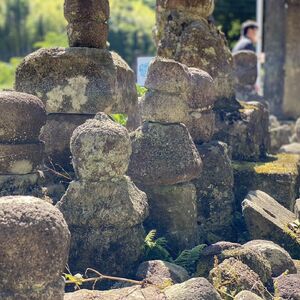
And so began the culture of placing stones over the buried. It was customary to erect a tombstone when aristocrats and great men died, but for ordinary people, only river stones were piled up.
【Muromachi Period】
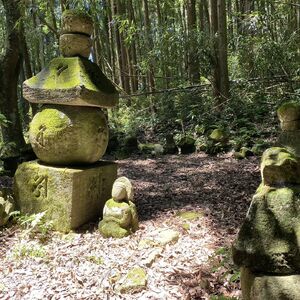
In the Muromachi period, "Yagura" is a famous grave. A yagura was built as a horizontal ossuary or memorial cave. More than 3,000 have been confirmed, but now many have been destroyed by landslides and settlement development, and the remaining yagura are weathered and look like mossy caves. It was richly decorated and contained many burial goods.
It was also during this period that the five-ringed pagoda, which is often seen today, began to be built.
In the Kanto region, it is called an itabi, which is made of stone and is written in ancient Indian Sanskrit Sanskrit characters. Stone pagodas began to be erected to engrave the date, year, etc. By the Muromachi period, the creation of stone monuments spread throughout the country.
【Sengoku period】
More than 15 graves of Oda Nobunaga, who is called the charisma of the Sengoku period, have been found throughout Japan. Tokugawa Ieyasu has 4 locations, Sanada Yukimura has more than 10 locations. In the graves of great men, in addition to the graves where the bodies were buried, hair, nails, and part of the bones are placed all over the country.
Samurai and people from wealthy families held a memorial service by placing a small ``Isseki Gorinto'', which was carved out of a single stone, although each part of the original five-ring pagoda was made of separate stones. rice field. Commoners began to build a single five-ring pagoda and hold a memorial service. However, these are memorial towers, not graves. There are not many records from this time, and there are various theories such as those that were thrown away in the mountains and rivers, or that they were buried on each site.
【Edo Period】
In the Edo period, the "Danka system" began, and ordinary people began to build graves. The parishioner system refers to the relationship between a parishioner and a temple under the condition that a certain temple exclusively handles the funeral services for each parishioner. It is a system born from the religious control policy of the shogunate. The shape and size of the tombstones also vary, and they differ according to social status and class. Simple shapes such as monuments and square columns were used by ordinary people, while large monuments and pagodas were used by feudal lords and the upper classes.
Since the late Edo period, it has become popular to engrave letters such as posthumous names and dates of death on gravestones.
[Meiji era/Taisho era]
In the Meiji era, the parishioner system was abolished, and cemeteries that were not bound by sects began to appear. Even in areas where burial was popular, crematoriums were set up as a measure against infectious diseases. In 1884, the first regulation on graves was the "Graveyard and Burial Control Regulations," which introduced a permit system for both cemeteries and crematoriums. It is regulated from the aspect of security maintenance and hygiene.
In the past, each person had their own grave, but as in modern times, a single grave has been handed down by many generations, and graves that were out of reach spread all over the country at once. rice field. Even in rural areas, cremation has become common, but until the early Showa period, burial and cremation were performed in parallel in areas with small populations and on islands.
【Showa Era】
The "Graveyard and Burial Control Regulations" stipulated in the Meiji period were abolished, and the "Graveyard and Burial Law" and "Law Enforcement Regulations for Cemetery and Burial" were established. It is also from the Showa period that graves engraved with the words “XX Family Grave” have become commonplace. Since the period of high economic growth in the 1930s, anyone can build a grave without hesitation, just like today. It was also during this period that the number of 'Juryo', where graves were built during life, increased. Cemeteries and cemeteries were developed in various places, and it became customary to build graves for the deceased and ancestors.
There was a time when death was considered unclean, but since the Jomon period, there has been a culture of burying the deceased, and the sorrow of the death of a loved one and the idea of holding a memorial service are common regardless of the burial method and era. In modern times, we must once again be grateful for the era and environment that provide a proper memorial service.
----------------------------------------------------------------------
Shimanami Memory
address: 114-9 Kamitoku Otsu, Imabari City, Ehime Prefecture
telephone number: 0898-47-3441
----------------------------------------------------------------------
NEW
-
-
2023.08.02legal affairs and leg...law and legal affairs Thank you for visiting. ...
-
2023.07.26About the memorial towerThank you for visiting. Today, let me talk abou...
-
2023.07.19About posthumous namesThank you for visiting. Have you ever heard the...
-
2023.07.12What the hell is the ...Thank you for visiting. Before I got a job at M...
-
2023.07.05history of graveshistory of graves In modern times, there are va...
-
2023.06.28What should I do with...What is shukatsu? What do you prepare from? Tha...
-
2023.06.21About prayer beadsThank you for visiting. My grandfather passed a...
-
2023.06.14About the five-ring t...Thank you for visiting. I joined the company in...
-
2023.02.07Ehime Graveyard | Wha...2023/2/4 Dear Ehime Prefecture, good morning. ...
-
2023.01.23What do the cucumbers...Hello! Thank you for visiting. I used illustra...
-
2023.01.16Oshima Stone in Imaba...Hello! Thank you for visiting. Have you ever ...
-
2023.01.11About visiting gravesHappy belated new year. Thank you for your cont...
-
2022.12.22Grave hunting in Imab...A cemetery is not only a place to store the rem...
-
2022.11.10Visiting a grave|The...hello. Shimanami memory, which is familiar with...
-
2022.11.10A blogger who publish...The homepage of the world's first completely ha...
-
2022.07.05Matsuyama City | Wher...hello. Shimanami Memory is familiar with comple...
-
2022.05.10Ehime Prefecture Tomb...What is the grave that I can't hear anymore? No...
-
2022.04.19Shimanami memory for ...Marine bone-cutting is a new form of offering t...
-
2022.04.19We have launched a ne...Thank you for visiting our blog. We have launch...


VIEW MORE
